Sunday, November 13, 2011

Everyone You Love is a Zombie


1977 was a good year for horror movies like Suspiria (Argento), and Martin (Romero), both which are now considered cult classics. At this time, a budding Canadian filmmaker named Daid Cronenberg, fresh off a series of student films and his first feature movie, "Shivers," gave the public a new twist on the zombie genre. Rabid is in some ways a zombie movie, sure, but its also a disturbing tale of love and infection.

All this starts out innocently, as a couple suffers through a terrible motorcycle crash. The girl has burns on her body, so a nearby plastic surgery clinic performs a risky and new procedure on her. Which saves her life, but results in her experiencing classic Cronenberg body mutation. The fact that she has a strange probe creature thing inside which leads to her infecting others in a wanton sexual bloodlust was fairly different for 70s horror. At the time, Cronenberg was still forming his own unique style-gory, horrifying movies that challenged people's previous notions of what was shocking.

One cannot ignore the fact that they were smartly made, too. Interesting that Cronenberg's disease outbreak merely predicted fears of outbreaks later on, ones that occurred in places such as the United States and Hong Kong. Although such scares didn't involve martial law, or shooting people, of course. The body horror element found in so many other Cronenberg movies is incredibly strong here, although his version of "Typhoid Mary" is less human than the actual one that did exist.

The best moment in the film happens when an infected woman turns into a zombie, and proceeds to attack a man on a crowded subway. Its a frightening moment, well executed, and an example of how to capture panic and fear onscreen. Despite its low budget limitations, and some week acting (Marylin Chambers though is really great in this), Rabid is a freaky and unreal depiction of a rather serious disease outbreak.

In some ways its inspired by Romero's lesser 1973 film The Crazies, but works in a less apocalyptic fashion, and is also more scarier. Since it further aided in the development of Cronenberg's career, and can be attributed to the expanding of his style of film making, this movie is rather notable. It also happens to still be one his best films. 92

Friend Request Pending

Editors note: This was written in 2010, way before the Oscars. So its a bit dated.


A more humorous title for this film would have been "Facebook: The Movie." When I first heard of this film, I wasn't sure what to think. Then the favorable reviews poured in, and I became rather curious. The Social Network lives up to the hype, largely because of David Fincher's direction, and also due to Aaron Sorkin's sharp screenplay. Whether or not its truly accurate (probably 60-70% true) is up for debate, especially considering Mark Zurkerberg's criticisms of the film. His reaction is rather unsurprising, because the movie paints him and most of the main players involved in a negative light. This shouldn't lead the audience to ignore the fact that the film also tackles the subject matter in a rather complex manner, one that is actually rather honest as well.

Really though that's often the nature of capitalism: its a nasty business, existing in an endless state of nature. The strong and smart survive; the weak and slow don't, and getting there first is all that matters. Sure Zurckerberg was incredibly smart, yet he also understood the concept of getting ahead. Even if it involved stealing an idea from what were supposed to be his collaborators, who were a pair of twins and their friend. Or going with the advice of a self-serving "friend" in Shaun Parker, even though that decision leads to his only friend, Eduardo, getting screwed over.

Zuckerberg's decisions lead him down a road that ends in great personal wealth, but also leave him feeling a bit empty. The final shot not only reflects this, but also manages to be pitch perfect and sadly humorous. I am somewhat reminded of Citizen Kane here with, Eduardo in the Joseph Cotton role and Zuckerberg's ex-girlfriend almost serving as Rosebud, or as Kane's second ex-wife, who never understood him. One could almost see this as being true, although I am not entirely convinced that Fincher and Sorkin have simply remade an American classic.

For one thing, The Social Network in the end has rather different subtexts, and tone wise the two movies are not the same. Unlike Citizen Kane, where we never understand Kane and that film's ending makes that clear, Fincher never leaves any doubt about who or what Zuckerberg really is. "Your not an asshole, Mark. You just try really hard to be one," is a perfect line, and expertly sums up what the audience is left to think.

In fact, that may be The Social Network's major flaw (there are minor ones, of course, but I'm not one to nitpick)-that its perhaps too easy to decide how one feels about Zuckerberg even though Fincher wisely abandons standard biopic cliches and makes a really smart movie. One that is really a truly 21st century movie for the modern, current technology based generation. Something that may date the movie when its examined decades later, that's a risk that most movies take, anyways.

Come Oscar time, hopefully Trent Reznor and Adam Ross' fantastic score doesn't get overlooked. Whether or not its great cast, Fincher and Sorkin, or anyone else involved gets noticed come awards time is irrelevant to me. Although one would hope that in a rather weak year, one of the best, if not the best, movies of 2010 gets a best picture nod, at least. 100

The Monster Within


Heavy on atmosphere and cloaked in an air of mystery and art house style, this film is very different from the average horror movie. At its hear though is a French retelling/twisting of previous so called "monster movies." There's something here that engrossed me, and required me to actually engage my brain. Something that all too many horror films do not actually require, although that's not necessarily a bad thing.

The "mad scientist" is the father of a horribly disfigured girl. A prominent plastic surgeon, he blames himself for her mangled face, ruined beyond almost all repair. In desperation, he has his lovely assistant kidnap young women; all in a vain attempts to give his daughter her face back. She has become a monster to a degree, inspiring pity in a handful of lyrical scenes. And yet with the blurry, quick glimpse of the terrible scaring, she frightens and horrifies the viewer. All of this reminds me in a way of Frankenstein's monster and other creatures who were born out of certain horrible experiences, and while also being somewhat sad due to not having the capacity to to live a "normal existence."

In this case, I have to note that the film doesn't completely sustain the rich, built up atmosphere. Although the musical score, which reminds me of the score for [i]Little Shop of Horrors[/i](1960) sounds like a demonic carnival, does work despite what some otherwise say. It works because by the final frame, we have witnessed something truly bizarre. There is of course also thoughts on beauty and how society prizes beauty to the point where it becomes vanity, but I thought that was rather obvious and not as important.

Besides all this, "Eyes" is a clear example of how horror can contribute to cinematic art, that the genre is much more than gore and random violence. For that alone it deserves to be noted, perhaps even celebrated. Although it falls short of greatness, this is a film that stands a very good chance of cracking my ever evolving Horror Top 50. 90

A Blessing and a Curse


Unlike the rest of David Cronenberg's 80s movies, this one is his "Most Normal," so to speak. Adapted from a novel by Stephen King, the film is a strange and eerie tale, a warning about the power of destiny. It does lightly touch upon body horror, as Christopher Walkien's Johnny Smith is strangely evolving, a part of his brain long dormant, suddenly mutating and coming alive, giving him the bizarre power to predict the future.

Unsurprisingly at first this power is viewed as a curse rather than as a blessing. Regarded as a freak and feeling strong alienation only made even more worse by what he's lost, Johnny decides in the beginning to to hide away, going inward into himself. This of course changes, notably because of the invisible powers that start driving him to help others, which is the movie's main theme. If you could see something terrible that would occur in the future, would you do something to change it?

The answer to that question is not so simple, especially in the case of Martin Sheen's chillingly portrayed, psychotic and charismatic presidential candidate. He too believes not only in destiny, but also thinks that he has been chosen by God to become president of the United States. While the movie properly explores how and why Johnny decides to use his power, its problem is that the film is too short-there are not enough cases of him using his power to help the viewer determine if its really a good or bad thing. Sure this leads to him helping people, yet people also brush his assistance aside, which really renders him a bit useless. Yet those people do so at their own peril, for he's never wrong-after all, destiny has selected him to be its unwilling vessel.

There's something also rather creepy and really odd about this entire movie. Perhaps its due to Walkien, who's always had a weird quality about him, or maybe its due to the really bizarre subject matter. Some terrible things happen during the film's running time, and they too serve a purpose. What one takes away from this movie is that Johnny is both a creature of sorts and also a man, possessing a rare gift that he uses for good, not evil or to play God. Interesting that such a change from Cronenberg's norm results in one of his best movies, although it still fits into his usual style. 90

Thursday, November 10, 2011

Hey kid, you want a toothpick?


Really I can’t get that song out of my head, although the same can be said for the rest of Drive’s fantastic soundtrack. Even though I have not viewed the movies that inspired what currently is the best movie I’ve viewed this year, that’s irrelevant since its 70s and 80s inspired style is quite noticeable and fairly obvious. Opening the film with shots of a shiny, neon-lit metropolis, the film wastes very little time in showing us its main character, a man who truly does not have a name, who remains to the movie’s final shot a mystery really undefined.

Which makes him like other previous cinema loners, men and even women who choose to abstain from company, not letting anyone truly get close to them. Despite those who argue that The Driver has some sort of mental disorder, be it autism or something else, I disagree-he is merely a man who says very little, choosing to let his emotions and actions dictate how people respond to him instead. His truly badass 1970s car is more of an extension of his personality, but it rather reflects who he truly is-and his Scorpion coated jacket is, to quote Nic Cage in Wild At Heart, “A symbol of my individuality.”

Naturally of course something has to go and ruin his carefully planned out and perfect world, as his decision to care about someone not only leads to lots of death and violence but also, as stated by Albert Brooks’ quietly menacing gangster, that “You will be looking over your shoulder for the rest of your life.” Despite all this, The Driver never stops planning ahead, striving to emerge from the mess of a situation that he really did not create in the first place. The city of LA, once a prime spot for him to make his way in the world, turns into an dangerous world that puts him in harm’s way, even more so than driving people on jobs around the city by night, or being a stunt man by day.

The cast for this movie is truly excellent, and even though characterization is a bit skimpy that can be excused when the story is air tight and the film does a great job of creating incredibly memorable and well crafted bits of montage that are very effective. Without Ryan Gosling keying this movie with a performance that is remarkable, the film wouldn’t work quite as efficiently. Acting mostly with expressions and his eyes, Gosling gives his character a strong, calm yet steely gaze that never goes away. He remains largely unflappable, choosing to express his rage only when the moment calls for it, such as in the elevator to protect Carey Mulligan’s character, or when he is forced to torture a man in front of his employees. Not to mention the fact that his scenes with Albert Brook’s Bernie are just as interesting, because Bernie does most of the talking and yet despite this the Driver never once tips his hand nor does he give the impression that Bernie actually frightens him at all.

Other notable aspects include the film’s daft handling of violence, choosing carefully when to display blood-letting, which figures in also to the movie’s overall daft touch and stunning visuals. The fact that the movie almost works as a loose version of Shane is also great, as the movie seems to mix film noir in with a western movie style that almost ignores its urban modern setting. Not to mention the finale, which is surprising and also highly fitting-despite what many people think, the film could not have ended any other way. Drive is an excellent addition to cinema, and in a world of crappy, over the top and too loud action movies such as Transformers and the Fast and the Furious series it’s rather refreshing. Not too many movies like this come along, and when they do serious cinema fans have a duty to give them their full attention. 100

Tuesday, November 8, 2011

Avoid Her Stare, Her Gaze is Poison


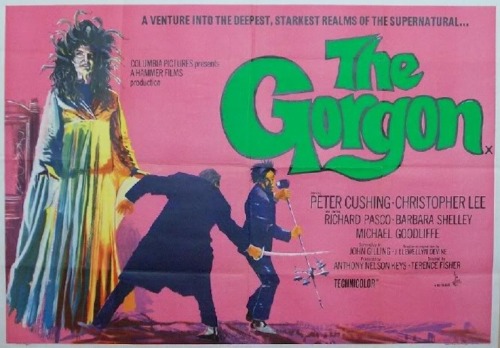
Known for his Dracula and Frankenstein movies, Terence Fisher also directed other Hammer Studios movies. One of those was The Gorgon (1964), set in 1800s Germany-the 1800s usually being the setting for most of Hammer Studios' movies. Despite starring Christopher Lee and Peter Cushing, this movie is a tad dull, and isn't as good as it could have been. Not only is the Gorgon introduced way too late, but the movie really moves too slow to build up any sense of dread or atmosphere.

Those two crucial elements were not missing in the Horror of Dracula or Curse of Frankenstein, although its not fair to compare this movie to those two classics. Still Cushing, and Lee in a smaller role elevate this movie to decent status, and the overall mystery is not too bad. The woman at the center of all this, who happens to be Cushing's assistant, is at least easy on the eyes. Hammer Studios films, considering they were filmed in 1950s and 1960s Britain, never really featured strong female characters.

Really a few entertaining scenes aside, this movie only becomes particularly interesting near the end. This type of story would have worked better in a much shorter form, or perhaps as just an episode of some horror/fantasy TV show. Too bad, since the myth of the Gorgon is actually quite fascinating.

Things That Go "Bump!" in the Night


Clouded in mystery, cloaked in secrecy, they dwell up in an utterly hopless land, upon which an ancient castle dwelling sits. Their desires and aims remain secret until a couple, like in so many horror movies, decides to travel up there, as the brides wishes to pay her relatives a visit. Little does she know that they are forever cursed, beings that drink only the blood of the living to satisfy their thirst. Anyone who enters this abode risks being transformed into a creature of the night, doomed to wander the earth forever as one of the undead.

Visually stunning and expertly shot, Le Frisson des Vampires; Strange Things Happen at Night (or titled The Shivers of the Vampires) is rather fascinating. The film's lack of a good budget is rather obvious, for the costumes are odd-at one point the head vampires are both dressed as if they just came from Woodstock-yet that in addition to the movie's weak acting can be overlooked. However, Jean Rollin does not properly explore his themes enough, nor is he unable to build upon them to create a movie that is actually greater than the sum of its parts. This is a shame, as he tackles the vampire in a manner rather different and interesting than most directors normally do. Really he would have benefitted greatly from working with Hammer Studios, but by the 1970s Hammer was falling into decline.

There is also the matter of the last act, which is a bit surprising and quite haunting. A choice is made, the issue of opting for damnation instead of salvation sealed by, funny enough, strong blood ties. Others make a rather different choice, yet in the end no one really finds true happiness, save for a select lucky few. One could mediate upon these things, but they would only uncover that fate is a cruel mistress.

Monday, November 7, 2011

You Never Know What You'll Encounter On That Dusty Road

Playing out as a strange dream gone horribly wrong, this cult film noir movie plays all the right notes. A man recounts his endless string of bad luck, events that occur in haunted flashbacks that to him seem more of a general haze than anything else. He was once a musician, now he's your average bum, playing gigs for very little and struggling to get bye. Despite heading towards California and his girl, he discovers as he lays it down straight to us, the viewer, why you never hitchhike.

Even though this movie's low budget limitations show through, the dialogue is still tense and tough, the film's bleak and mysterious atmosphere rather strong. Since the poor loser who is the film's protagonist has very little idea of why any of this is happening to him, neither does the viewer, and its fascinating to sit back and watch as he encounters both an odd stranger and then later you standard female fatale.

Most of the film is also remarkable for setting film noir standard cliches, or at least being one of the earlier most famous film noirs to help pave the way for others. Even though Out of Past, a much better film noir came out two years later, this picture is a good one in its own right. Interestingly enough it also helped inspire some better movies decades later, as I'm fairly sure that David Lynch borrowed from this movie for his underrated and excellent Lost Highway.

Thursday, November 3, 2011

We Interrupt This Horrorfest To Bring You The Following


Or quite frankly, you never know what you might find while digging through the Internet. In the process of trying to properly cover tax plans drawn up by the many GOP nominees, I stumble onto this little fun tidbit that I have to be certain others must know about, too. That Herman Cain stole, borrowed, whatever have you, his 9-9-9 tax plan from a video game. That's right, a video game. I'm not making this up.

Here's the link: http://www.dailymail.co.uk/news/article-2048969/Did-Herman-Cain-999-tax-plan-SimCity-video-game.html

Really you've got to be kidding me. This is supposed to be the potential nominee for the GOP in November 2012, and he's taken his main bread and butter tax plan from Sim City 4. From a sequel, I might add. Now granted these days originality is practically dead, and everything has been done before, but this is ridiculous. Never mind the recent stories about Cain being accused of harassment, which to their credit The Daily Show managed to make them funny despite them being really creepy and alarming, the fact that his tax plan is even more of a shame than previously thought is eye opening. This is even more important because the election will, despite any attempts by either the GOP or President Obama and the Democrats, come down to economic issues. Who has the best tax plan, which will help lower the deficit and cut spending?

Never mind that Cain's plan will hurt him dramatically in New Hampshire, one of the states that does not have a sales tax. Not to mention Alaska, which is able to use profits from taxes on oil to also avoid having a sales tax. I would laugh about the 9-9-9 plan, but since Cain has a shot at actually winning Iowa and is running high in the polls, taking a good hard look at something that could be a complete disaster if enacted is absolutely crucial. It’s bad enough that Rick Perry is floating the dead horse issue of a flat tax, too.

Although really our glorious leader, President Obama, has yet to even tackle tax reform. Sure he's cut taxes and let the Bush tax cuts for the rich continue onward, but it’s clear that he's either saving the need to reform the tax system for later, or maybe not at all. This country does need to have a serious discussion about how to better improve a system that actively requires to so many people to hire someone else to actually do their taxes. That's outrageous, and sadly not surprising; at the same time though, what they do not need is a plan taken from a game where you can build your own magical city. Fantasy land shouldn't be the basis for actual policy.

Wednesday, November 2, 2011

Nightmares and Ax Murders


Produced by the legendary Roger Corman, who is as much responsible for modern cinema as anyone else, Dementia 13 (1963) was directed by Francis Ford Coppola before he became world famous and created four masterpieces in the 1970s. Despite not being as great as his best work, its still a good solid film that has a decent atmosphere and is in some regards rather eerie. Plus it sports a demented and creepy film score that is underrated.

Desperate to keep her share of her husband's family fortune, a woman covers up the death of her husband and comes to stay at his family's foreboding and old castle in Ireland. While there, she uncovers a dark secret, only to come face to face with a madman wielding an ax. Although the first act is largely set up, when the viewer and the scheming woman encounter the film's primary villain, the movie becomes much more interesting. For you see, a girl drowned years ago, and within this mystery lies the answers to what is really going on with a family who's mother feels is cursed.

Even thought this movie is not scary, there are some good tense moments and Coppola manages to keep the film's secrets mostly hidden until the final act. A couple of scenes feel rather fresh, and the movie overall has a strange quality to it-in some ways Dementia 13 is more old fashioned gothic chiller than it is a 1960s slasher movie. Thankfully Coppola moves events along, and is wise to not draw out anything at all.

Although the film's low budget style and trappings result in a weak cast and limited effects, Coppola used this movie to try and be noticed. The fact that Corman saw something in a man struggling to get his start in Hollywood and gave him an opportunity, later being proven right about said fellow's talents, is why Corman's true talents lay beyond merely making movies geared to make a profit.